Guide
What Is Shan Gui Hua Qian? Shan Gui Coin Meaning
Shan Gui Hua Qian is a traditional Chinese talisman coin form known for its round body, square center hole, and dense symbolic inscriptions.
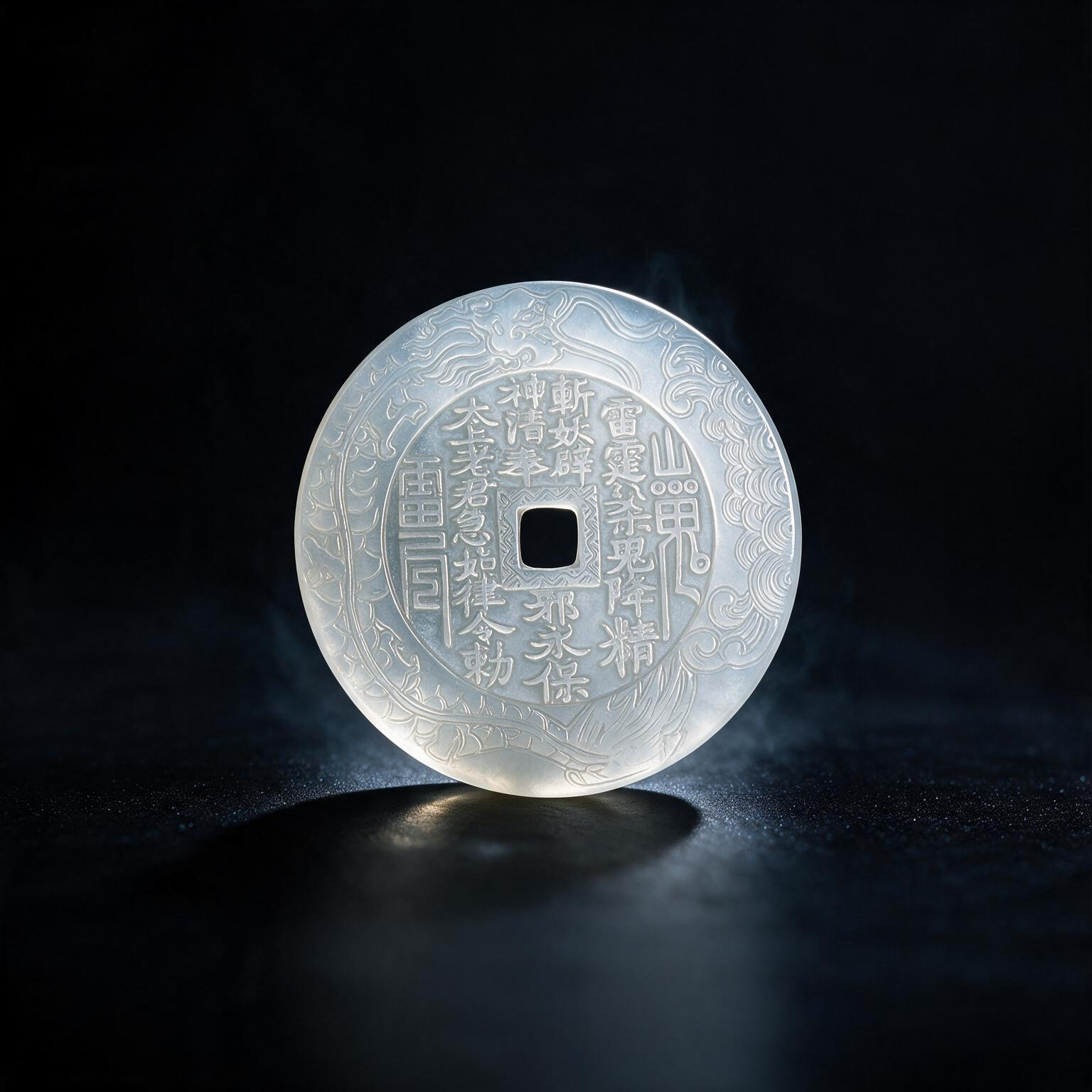
What does Shan Gui Hua Qian mean?
Shan Gui Hua Qian (山鬼花钱) refers to a type of Chinese coin charm, rather than ordinary circulating money. The name alone is not a complete translation of its design: its protective meaning needs to be understood through the inscription and symbols on the particular example.
The British Museum's Money Gallery guide, Case 11 (PDF) discusses a charm bearing stylized 山鬼雷令 characters in relation to a thunder command directed at mountain demons. This is a religious meaning attached to an object, not evidence that a modern pendant can prevent harm.
What do the inscriptions refer to?
A useful comparison is the copper-alloy Lei Ting coin charm, TEMP.02959, at Cambridge's Museum of Archaeology and Anthropology. Its record identifies a thunder-related command against demons on the front and the eight trigrams on the reverse. This grounds the protective interpretation in a documented object rather than the atmosphere of a product image.
That record describes one example. It should not be used as a word-for-word transcription of every Shan Gui-style charm: lettering, arrangement, borders, and reverse designs need to be checked separately. Our generated concept images are not suitable evidence for authenticating or translating an old coin.
The square hole and the reverse design
The round body and square opening echo historical Chinese cash-coin forms, but that shape is not unique to Shan Gui charms. It does not, by itself, identify an object's age, purpose, or authenticity.
The Cambridge example has a bagua, or eight-trigram, reverse. When comparing a charm with a reference, inspect both faces rather than assuming that a similar front guarantees the same back. The reverse is part of the identification, not an interchangeable decorative surface.
Shan Gui coin and Taoist talisman language
The command-like inscription helps explain the connection with Taoist talismans. It is more specific than a general wish for luck. Describing that religious language is different from claiming that every replica has a ritual role.
For the wider context, read our guide to Chinese amulet coins. Not every coin charm has the same inscriptions or belongs to the same tradition.
Historical charm or modern interpretation?
A contemporary object may borrow a historical outline or inscription without being an antique or an exact reproduction. Ask for clear photographs of both sides, the material specification, dimensions, and an explanation of what has been adapted.
A rendering cannot establish material quality, workmanship, or authenticity. If a design is still a concept, those limitations should be clear before anyone is asked to buy it.
Our interpretation
Daoist Charm does not treat Shan Gui Hua Qian as a supernatural guarantee. We use it as cultural inspiration for a modern symbolic object: something to carry, gift, study, and remember.
Our first concept, the Water Jade Shan Gui Coin Charm, explores a translucent jade-like appearance. It is not an antique, an authenticated replica, or a consecrated talisman. Final materials, dimensions, and production details remain to be confirmed.
First Charm
See the Water Jade Shan Gui Coin Charm
Explore our first Shan Gui-inspired coin charm concept, designed as a symbolic protection amulet and meaningful jewelry object.
View the product conceptFrequently Asked Questions
What is Shan Gui Hua Qian?
Shan Gui Hua Qian is a Chinese talisman coin form known for its round body, square center hole, dense inscriptions, and protective symbolic language.
Is Shan Gui Hua Qian real currency?
Shan Gui Hua Qian is best understood as a talismanic or amulet coin form rather than ordinary circulating money. Its value is symbolic and cultural.
What does a Shan Gui coin mean?
A Shan Gui coin is commonly discussed as a protective talisman coin, with inscriptions and motifs connected to warding off harmful forces and invoking symbolic protection.
Why does a Shan Gui coin have a square hole?
It follows the shape of historical Chinese cash coins. The square hole is not unique to Shan Gui charms and cannot establish the age, authenticity, or meaning of a particular example.
How does Daoist Charm reinterpret Shan Gui Hua Qian?
Our Water Jade Shan Gui Coin Charm is a contemporary design concept with a translucent jade-like appearance. Its generated images are not photographs of a historical object or a finished product, and we make no promise of supernatural protection.